
When Was the Last Time You Checked Your Savings Account Interest Rate?

Here’s a story that has stuck with me for over 30 years.
When I was still in college, my best friend, who was majoring in Finance, once asked me what Annual Percentage Yield (APY) I was getting on my savings account with the local bank.
“About four percent,” I confidently told him.
There was just one problem. I had absolutely no idea what APY I was earning.
At some point, someone had told me it was around 4%, and I assumed it stayed there forever. Because that's how banks work, right?
(Spoiler: that's not how banks work.)
When I finally checked, the rate was closer to 2%.
Changing banks was a huge pain back then since nothing was done digitally yet. So I kept my account where it was.
I also didn’t think it was a big deal. After all, it was just 2%. (Two percent is actually a big deal, but more on that later.)
Since starting my journey to early retirement 13 years ago, I vowed to never earn such a low return on my money ever again.
Yet, when I checked my savings account with CapitalOne earlier this week, I found myself in a familiar position. I was getting an APY of just 1%.
I don’t know how I missed this. Perhaps achieving early retirement gave me a false sense of confidence.
I share this as a cautionary tale because you could be in the same boat if you bank with CapitalOne. But even if you don’t, when was the last time you checked your APY?
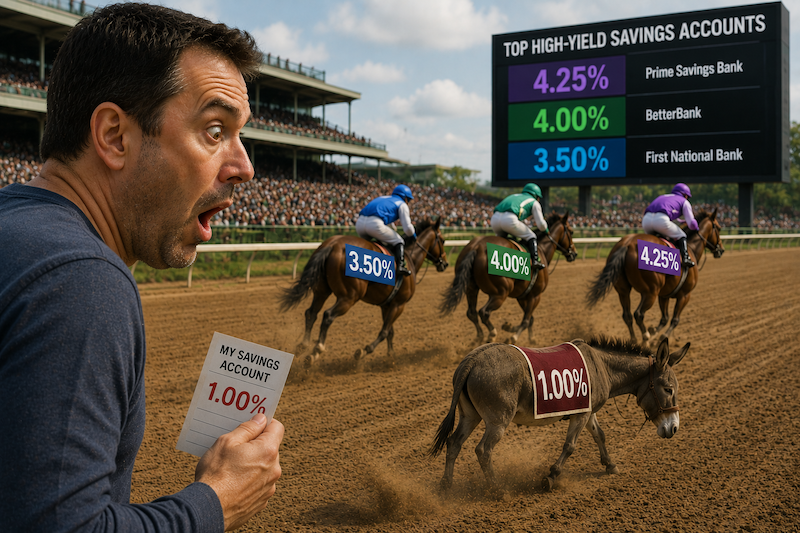
HOW MY "HIGH-YIELD" SAVINGS ACCOUNT STOPPED BEING HIGH YIELD
I had opened a 360 Savings account with CapitalOne many years ago. I don’t remember what the APY was at the time, but it was a high-yield savings account (HYSA).
I hardly ever used the account, so I never bothered to periodically check the APY. But since it was an HYSA, I assumed I would always be earning a higher rate.
The problem? It quietly stopped acting like a high-yield savings account years ago, and I never noticed.
In 2019, CapitalOne introduced its newer HYSA—the 360 Performance Savings account—with a competitive APY (currently around 3%). Meanwhile, the older and similarly named 360 Savings account stopped being offered to new customers. Its APY also dropped to basement levels (as low as 0.30%).
Existing customers weren't automatically moved to the newer account, which meant many people continued earning much lower rates without realizing it.
Consequently, a class-action lawsuit was filed against CapitalOne because of this. I received a notice of the lawsuit last October, but I didn’t pay much attention to it. And I missed the part about not being migrated to the new HYSA.
I’ve since moved all my money over to the higher-earning account. And fortunately, there wasn’t much money in there to begin with, but 1%? Yikes!

WHY A 1% APY IS WORSE THAN IT LOOKS
A 1% APY is abysmal because of inflation.
Inflation doesn't move in a straight line, but over long periods it has averaged about 3% annually. That's why I use 3% as my personal minimum benchmark. If my money isn't earning at least that much, it's probably falling behind.
If inflation doesn’t worry you, you’re not alone. Inflation is often explained as having to spend $103 this year on something that cost $100 last year. But $3 doesn’t sound significant, so it doesn’t cause alarm for many people. And that’s what makes it scary.
People tend to forget that inflation compounds. You’re not just paying $3 more than the previous year. That amount will grow. After 24 years, you’ll be paying roughly $200 for something that cost $100 today because of inflation.
Here’s another way to look at inflation.
Imagine you have $200,000 sitting in cash at home today, and you end up in a coma. Then, when you wake up 24 years later, you only have $100,000 left. Inflation works like this because it destroys the value of money.
The solution?
Have as much money as possible in accounts earning far more than 3%.

WHERE I KEEP CASH INSTEAD
My CapitalOne mistake also reminded me that not all dollars need to sit in the same place. Once I know when I'll need the money, I can choose the account that gives me the best balance of return and flexibility.
MONEY I'LL NEED SOON
Any money I’ll need in the next few months stays in a high-yield savings account with an online bank.
A savings account won't make you rich, but there's no reason to settle for a lousy APY when better options are only a few clicks away.
MONEY I'LL NEED WITHIN A YEAR
Money that I’ll need in about 6-12 months will go into Certificates of Deposit (CDs) if they’re paying better than the HYSA. For slightly more interest, I’m willing to lock up my cash for several months.
The downside of CDs is reduced flexibility. If you need the money early, penalties can wipe out much of the extra interest.
One trick to give myself more liquidity is to use a CD ladder, where I divide the money into multiple CDs with different maturity dates instead of a single CD. This way, I won’t have to wait as long to access some of my cash if I need it.
MONEY I WON'T NEED FOR YEARS
Any remaining money is invested in individual stocks and a few ETFs to generate the highest returns through my taxable brokerage account.
I leave the money in this account for as long as possible to maximize compounding and to take advantage of the 0% capital gains tax bracket.
FREQUENTLY ASKED QUESTIONS
How Often Should I Check My Savings Account Interest Rate?
At least once or twice a year. If my CapitalOne experience taught me anything, it's that a savings account that was competitive five years ago might be terrible today.
What Is Considered a Good Savings Account APY?
It changes with interest-rate conditions, but online high-yield savings accounts generally pay significantly more than traditional brick-and-mortar banks. Bank of America, for example, currently offers an APY of just 0.04%. That means that a $10,000 deposit would earn a pathetic $4 of interest after a year. Not even enough for a shopping spree at the dollar store!
Can a High-Yield Savings Account Stop Being Competitive?
Absolutely. Mine did. That's the entire reason you're reading this article.
GIVE YOUR ACCOUNTS A QUICK CHECKUP
My CapitalOne mistake was a good reminder that financial success doesn't make you immune to financial mistakes.
Thirty years ago, I ignored my savings account rate because I didn't know any better. This time, I ignored it because I assumed I knew better.
Different reasons. Same result.
If you haven't checked the APY on your savings account lately, take two minutes and look. Seriously.
You might discover your money is working harder than you thought. Or you might discover it's quietly taking a nap.
Either way, you'll know. And knowing beats assuming every time.
See you at the finish line!
Disclaimer: I’m not a licensed financial professional. This blog shares my personal experiences and opinions around money, investing, and early retirement. It’s for informational and educational purposes only—not financial, legal, or tax advice. Always do your own research or consult with a qualified professional before making any financial decisions.


Comments