
Is Investing Just Gambling? The Difference Most People Miss

I'm currently watching the FIFA World Cup—my favorite sporting event. A friend and I have even placed a few bets on the matches.
We couldn't approach gambling more differently. He'll happily throw hundreds of dollars on long shots. I stick to "sure things," and even then, I rarely bet more than $20. Gambling makes me nervous.
But here’s the strange part.
That same person who hesitates to bet $20 won't think twice about investing $20,000 in a stock.
You might be thinking, “But isn’t investing basically gambling?”
At first glance, that sounds reasonable.
You risk money.
You don't know the outcome.
You can win or lose.
So what makes investing different?
Here's the surprising answer:
It's not the risk. It's where the wealth comes from, how time works for or against you, and what your money actually buys.

WHY INVESTING AND GAMBLING SEEM SO SIMILAR
Some people avoid investing because they equate it with gambling. And it’s easy to see why.
With both investing and gambling, you risk losing money for an uncertain positive outcome. No amount of research can reduce your risk to zero.
And because money is involved, emotions can be stoked. Seeing your bet or investment come through is an adrenaline rush. Similarly, the sting of a loss can hurt like hell.
But that's where the similarities begin to end.
WHERE YOUR RETURNS COME FROM
One of the biggest differences between investing and gambling is how wealth is created and distributed.
GAMBLING REDISTRIBUTES WEALTH
With gambling, no new wealth is created. Money simply gets redistributed.
Take any casino game, such as Blackjack or roulette, for example. Payouts to the winners are funded by the losers. Someone has to lose for others to win.
As the middleman, the casino pays out most of the money it collects but keeps a small percentage. It profits from every game over the long run.
Lotteries are no different.
Prize winnings, including the jackpot, are funded by ticket sales. And the government keeps a significant portion of the revenue before prizes are awarded.
Again, no wealth is created. Money simply moves from the hands of losers to winners. Your gambling bet is a chance to be on the receiving end of that transaction.

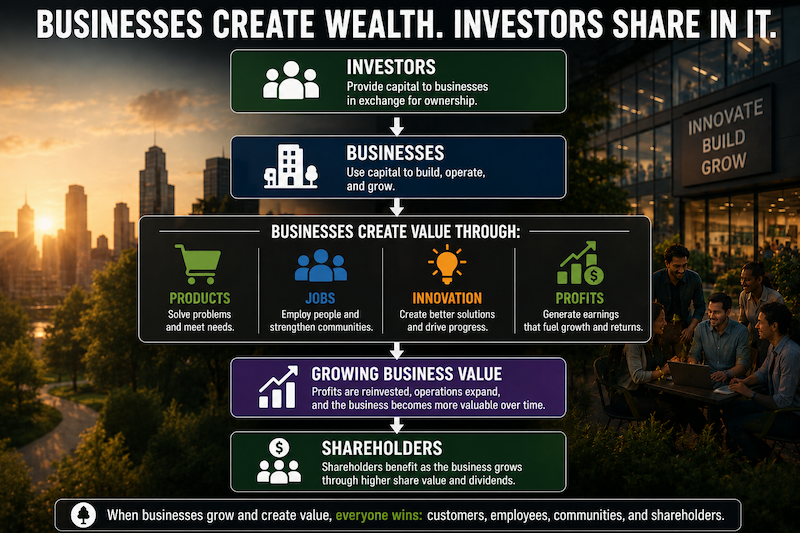
BUSINESSES CREATE WEALTH. INVESTORS SHARE IN IT.
Investing allows you to participate in wealth creation.
When you purchase stock in Costco, for example, you purchase partial ownership in a real business with employees who sell products and services.
As Costco grows, it can generate higher profits, expand into new markets, and increase the value of the business. As a shareholder, you participate in that growth and benefit from the stock price rising.
With investing, nobody has to lose for you to win. Everyone can benefit at the same time.
HOW TIME CHANGES THE ODDS
A second difference between gambling and investing is how time works for or against you.
TIME WORKS AGAINST GAMBLERS
All gambling bets have a predetermined end. It could be when the roulette wheel stops, when lottery numbers are drawn, or when a sports match is over. Regardless, gambling forces winners and losers to be decided so money can be shifted from one to the other.
Short expirations also mean more bets can be placed, and the house always has a slight edge in all bets. Casinos may lose money in the short run, but the more bets are made, the closer results move toward the house advantage.
The same principle applies to something as simple as flipping a coin.
If you were to flip a coin just 10 times, the coin might land heads seven out of the 10 times. But if you were to make thousands of coin flips, the odds of landing heads or tails come closer to 50%.
Simply put, gamblers always lose against the house in the long run.
TIME IS AN INVESTOR'S GREATEST ALLY
"Our favorite holding period is forever.”
—Warren Buffett, Investor
Unlike gambling, time is an ally for stock investors. Investments have no set expiration. You can hold an investment for as long as you choose.
Assuming you’ve bought shares of a business with a strong economic moat, the longer you hold your shares, the more time earnings, dividends, and especially compounding have to work in your favor. Compounding doesn’t give the instant payout that gambling does. But give compounding time, and it becomes powerful.
Holding longer also allows investors to ride out short-term stock price dips just like how casinos ride out short-term losses.
My own portfolio has dropped in value many times over the years, including a 40% drop in 2022. Each time, though, it eventually recovered and rose higher.
Historically, time has increased the odds of success for long-term investors because strong companies generally grow over time. Stock prices may occasionally drop for a number of reasons, but over the long term, they tend to reflect the earnings and fundamentals of the business.
Every gamble eventually forces a winner and a loser. A great investment can continue creating value for decades, allowing you to decide when—or if—you want to sell.

WHAT YOU'RE ACTUALLY BUYING
The final difference between gambling and investing is what you actually get for your money.
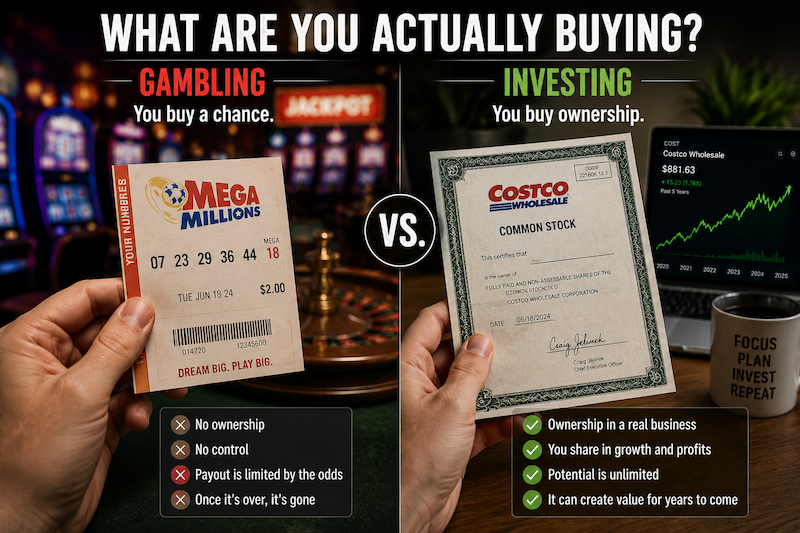
When you buy shares of a business like Apple, Costco, or Microsoft, you become a part owner of that company. That ownership has real value because the business creates products and services, earns profits, and can continue growing for years or even decades.
As the business grows, you share in its success through rising stock prices and, in some cases, dividends. Best of all, there's no theoretical limit to how valuable a great business can become over time.
When you place a bet, on the other hand, you don't buy ownership of anything. A lottery ticket, slot machine spin, or roulette bet simply buys you a chance to win some of the money collected from everyone else playing.
Unlike a successful business, a bet can't continue creating value after you place it. Its maximum payout is fixed by the odds, and once the event ends, so does the opportunity.
Fortunately, you don't need a finance degree to tell the difference. The next time you're tempted by an opportunity to make money, ask yourself these four questions.
FOUR QUESTIONS TO TELL INVESTING FROM GAMBLING
Am I buying a productive asset?
If yes, you're probably investing.
Can this asset create more value over time?
Businesses can. They hire employees, sell products, innovate, earn profits, and grow. A roulette wheel, lottery ticket, or sports bet creates nothing. Money simply changes hands.
Does someone else have to lose for me to win?
If the answer is yes, you're probably looking at gambling or speculation.
Does time work for me or against me?
If the opportunity has a built-in expiration date and the more you repeat it, the closer you get to a negative expected outcome, it's probably gambling. If you can hold it for years while it continues creating value, it's probably investing.
THE REAL DIFFERENCE
At first glance, investing and gambling seem remarkably similar. Both involve risk, uncertainty, and the possibility of losing money.
But once you look beneath the surface, the differences become clear.
The real difference is this:
Gambling redistributes existing wealth.
Investing helps create new wealth.
Gambling has a deadline.
Investing rewards patience.
Gambling depends on predicting an outcome.
Investing depends on owning productive assets.
That's why casinos and lotteries may all offer the excitement of making money, but only investing allows you to participate in the long-term growth of productive businesses.
You don't build financial independence by hoping to beat the odds.
You build it by patiently owning productive assets that can grow in value over time.
Disclaimer: I may hold shares of some of the companies mentioned. I’m not a licensed financial professional. This blog shares my personal experiences and opinions around money, investing, and early retirement. It’s for informational and educational purposes only—not financial, legal, or tax advice. Always do your own research or consult with a qualified professional before making any financial decisions.


Comments