
The Final Steps We Took Before Retiring Early

In one of my first blog posts, I wrote about the five things everyone needs to plan for before retiring. I focused on big-picture items: money, health insurance, social connections, how you’ll spend time, and identity.
But there’s another part of retirement planning that doesn’t get nearly as much attention: the things you need to do just before actually leaving your job.
Some of it’s financial. Some of it’s administrative. And some is making sure you don’t leave behind any money or benefits you’ve already earned.
When my wife and I decided to finally retire early in 2025, we didn’t just one day decide to retire at the end of the month. We started preparing for our exit out of the rat race months in advance.
These preparations helped us leave our jobs with fewer loose ends and, in a few cases, quite a bit more money.
So if my earlier post was about planning for retirement, consider this one the “Okay, we're actually doing this” version.

WE DIDN'T HAVE A RETIREMENT DATE—UNTIL WE DID
Even near the end of our FIRE journey, we didn’t have a specific early retirement date in mind. We just wanted to be ready for when we decided to cross the finish line.
A few years before actually retiring, we both started to feel that time was coming up.
Our jobs no longer gave us the same fulfillment that they used to. We found ourselves simply going through the motions each day, waiting for the weekend.
We were in great shape financially, having already reached financial independence a few years earlier. More and more, we began to question why we were still working.
So we started to make preparations for our exit.
BUILD OUR RETIREMENT CASH CUSHION
The first thing we did was build a cash cushion large enough to cover several years of living expenses.
How did we figure out how much we needed for living expenses each year?
That part was easy.
We’ve been tracking all of our expenses on a kakeibo for years. Not only did we know exactly how much we spent total each year, we knew how much was spent per expense category.
Building a large cash cushion was a pretty big change for us. For most of our investing years, we kept very little cash sitting on the sidelines. Even now, over 80% of our money is still invested.
But as retirement got closer, we wanted a bigger financial runway. We didn't want to be forced to sell investments to pay the bills during our first few years of retirement.
Fortunately, we had already started accumulating more cash a few years earlier. At the time, our reasoning was simple: we couldn't find great stocks selling at great prices. Rather than force ourselves to invest just because we had money available, we were happy to wait.
Once we decided to retire, that cash took on a new job. Instead of waiting for the next great investment opportunity, it would help fund our living expenses.
We also had some strategic reasons for wanting a larger cash cushion. Living off savings could help keep our income low enough to qualify for health insurance tax credits if we needed coverage through the ACA Marketplace. It would also give us more flexibility to harvest capital gains in the 0% capital gains tax bracket and eventually use a Roth conversion ladder to access some of our retirement savings.
Of course, we didn't want our giant pile of cash to just sit there earning next to nothing. So we divided it into chunks and put the money into CDs with different maturity dates, creating a CD ladder.
The CDs won't make us nearly as much money as our stock investments have over the long run. But that's not really what this money is for. This is our retirement runway.
And having several years of living expenses sitting safely on the sidelines gives us something else that's valuable in early retirement: options.
With our financial runway in place, we turned our attention to something a little more fun: how to use up the vacation we'd earned before we left.

USE OUR VACATION BEFORE WE LEFT
In 2024, we didn’t have a date yet, but we knew 2025 would be the year we would retire.
So, the first thing we did was plan the vacations we’d take before retiring.
Of course, we’d soon have all the time in the world to go on trips, but we wanted our paid vacations. We earned them, and we were going to take as much as we could.
I had Flexible Time Off, so I wouldn’t be able to cash out any vacation time at the end of the year. That was more incentive for me to take paid vacations while I could.
My wife, on the other hand, was paid hourly and had a huge PTO balance. Luckily, even with the vacations we had planned, she would still be able to cash out the maximum vacation time allowed at the end of the year.
That PTO payout money would go towards our cash horde.
With our vacations planned, we could start narrowing down when we'd actually leave. That meant looking at two things that could put a few thousand dollars in our pockets: bonuses and 401(k) vesting.
CHECK OUR BONUS AND 401(K) VESTING SCHEDULES
With a retirement year in mind, we then looked at narrowing down the actual date.
Since we were both in bonus-eligible positions, we checked if and when we might receive bonus checks.
We both learned that for the 2024 fiscal year, we were most likely to get bonuses. My wife’s company gave them out at the end of December. I was most likely to receive mine in March.
That put our possible retirement date as early as mid-spring.
Next, we checked the vesting schedules for our 401(k) accounts. Some 401(k) plans have vesting schedules for employer contributions. They serve as an incentive for employees to stay with the company.
With vesting schedules, the balance in your 401(k) isn’t entirely yours—i.e., fully vested—until a certain time. Your own 401(k) contributions are always 100% vested.
However, employer contributions, such as matching contributions, may be subject to a vesting schedule. Ownership can either gradually transfer to you bit by bit each year or all at once on a specific date.
My wife had been with her employer for 25 years, and so she was fully vested. Her entire 401(k) balance was hers to keep.
I, on the other hand, was 80% vested, and I would be fully vested until the end of August 2025.
So I had a decision to make: Do I quit in the spring after I get my bonus, or do I wait until my 401(k) is entirely mine?
I calculated that I would receive about $3,000 more by waiting. For me, that extra $3,000 wasn’t worth grinding it out another 4-5 months, especially since my investments make much more monthly.
We both decided to retire in the first half of 2025.
But our specific retirement dates would depend on when we actually received our bonuses and how we’d handle health insurance.
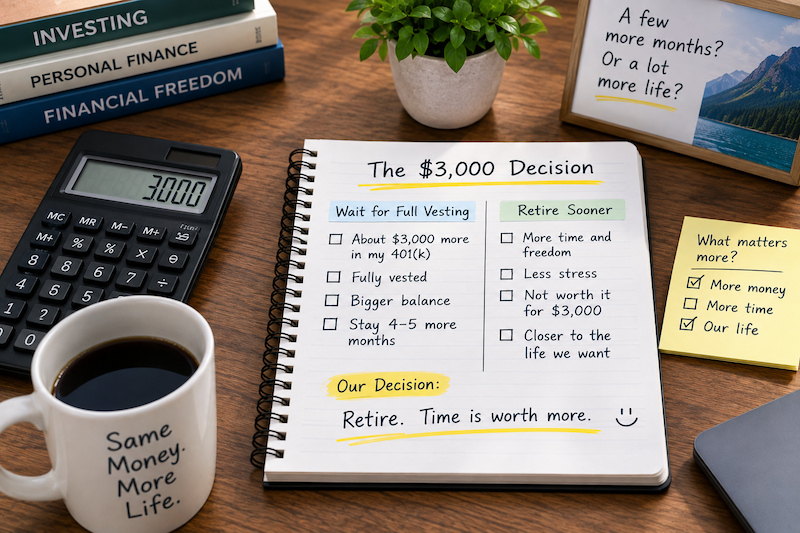
FIGURE OUT HEALTH INSURANCE
We knew eventually we’d have to shop for our own health insurance. But COBRA coverage was an option in the short term if it made financial sense.
We both checked with our employers how much COBRA coverage would cost to individually stay on our health plans. And how much it would cost to add a spouse as a dependent.
My wife's health plan provided fantastic coverage but was too expensive. Adding her as a dependent to my plan was the most cost-effective. Our premiums would be about the same as purchasing our own insurance, plus we could keep the same doctors.
Since I’d be adding her to my plan, she needed to retire before I did. Once she left her job and lost her employer-sponsored coverage, she could qualify for special enrollment in my employer’s plan. But that option depended on me still being an active employee when she lost her coverage.
In other words, the order in which we retired mattered.
She had to go first. I would follow a couple of months later.
My wife decided to retire at the end of February. As for me, after briefly considering retiring on April Fool’s Day to leave people wondering, I decided to target April 30 as my official day.
KEEP OUR RETIREMENT PLANS TO OURSELVES
Knowing you’re retiring soon, it’s tempting to tell your employer right away.
A part of you wants to tell your peers how you’re retiring much earlier than they probably will. There’s a satisfaction of seeing people look at you in amazement and envy as you cross the finish line first.
And if you love the team you’re leaving behind, part of you also wants to leave as a hero and give them as much time to prepare for your departure.
Or, if you hate your job—not us—maybe you want to rage quit and tell your employer to shove it, knowing they can’t do anything.
Except that they possibly can.
Our annual bonuses, like many, were discretionary bonuses, meaning that they were not guaranteed. It’s completely up to the employer whether or not to give discretionary bonuses and when. They are intended to incentivize employees to remain with the company.
Because our bonuses were discretionary, we didn't want to assume we were entitled to them before the checks actually arrived. Depending on the employer and the terms of the bonus plan, announcing a resignation beforehand could affect eligibility.
So, we both kept our mouths shut. Only after we confirmed our bonus checks had been received did we announce our intentions.
And we still each gave our employers over a month's notice. That way, we could ride off into the sunset as heroes.
With our last dates made official, one piece of business remained—deciding how we’ll manage our 401(k)s after we leave.

HAVE OUR RETIREMENT ACCOUNTS READY
During our careers, we both had built large 401(k) balances.
Since we weren't changing jobs, we could have left our 401(k)s where they were. But our plans charged administrative fees and offered fewer investment choices than we wanted. So we decided to roll them into traditional IRAs. Plus, doing so would give us the option to create a Roth conversion ladder.
Up until this point, I had only ever had Roth IRAs, and my wife only had traditional IRAs. So we opened new retirement accounts, giving each of us a traditional and a Roth IRA.
Couldn’t we just roll over the entire 401(k) balances directly into our Roth IRAs? Sure, we could. But since Roth IRA contributions are after-tax contributions, rolling over large amounts would trigger huge tax liabilities.
Rather than converting a huge amount all at once and creating a giant tax bill, we could convert smaller amounts over several years and manage the amount of taxable income we create each year.
Technically, we could have opened the IRAs after we retired. You don't need a job to open an IRA, and rollovers and Roth conversions don't require employment. But new IRA contributions generally require taxable compensation.
Still, we wanted the accounts ready to go before we retired, so we opened them while still employed.
KEEP A DOOR OPEN AFTER RETIREMENT
This last piece is actually something that happened after retirement.
My wife never had a LinkedIn account, but I did, and it had helped me in my career. I had several hundred connections, including people I had worked with in one capacity or another.
Updating my LinkedIn profile made retirement feel very real. It was my official announcement of a huge life change.
At first, I had planned to delete the account entirely, but that felt too conclusive. Plus, I sometimes have old friends who find me through LinkedIn. So I decided to update my profile instead.
But I didn’t actually announce that I had retired. Instead, I kept it open-ended, saying that I may be open to certain types of projects.
I have no foreseeable plans to work again, but who knows? Maybe part-time work is in my future.
And this way, I keep my door open for possibilities. I like having options.
ONE LAST THING BEFORE YOU CROSS THE FINISH LINE
None of this is meant to be a universal retirement checklist. We did these things because they made sense for our situation, and some of them may not apply to you at all.
But there is one lesson I'd take from our experience: don't confuse being ready to retire with being ready to quit.
We had spent years saving and investing so we could leave our jobs. It would have been silly to rush out the door and leave money, benefits or options behind just because we were excited to be done.
So before you hand in that resignation letter, take one last look around. Check your vesting schedule. Check your bonus. Use the vacation you've earned. Figure out your health insurance. Make sure your retirement accounts are ready.
You've spent years working toward the finish line. Take a few extra minutes to make sure
you're not leaving anything behind.
Then go.
We did.
See you at the finish line!
Disclaimer: I’m not a licensed financial professional. This blog shares my personal experiences and opinions around money, investing, and early retirement. It’s for informational and educational purposes only—not financial, legal, or tax advice. Always do your own research or consult with a qualified professional before making any financial decisions.


Comments